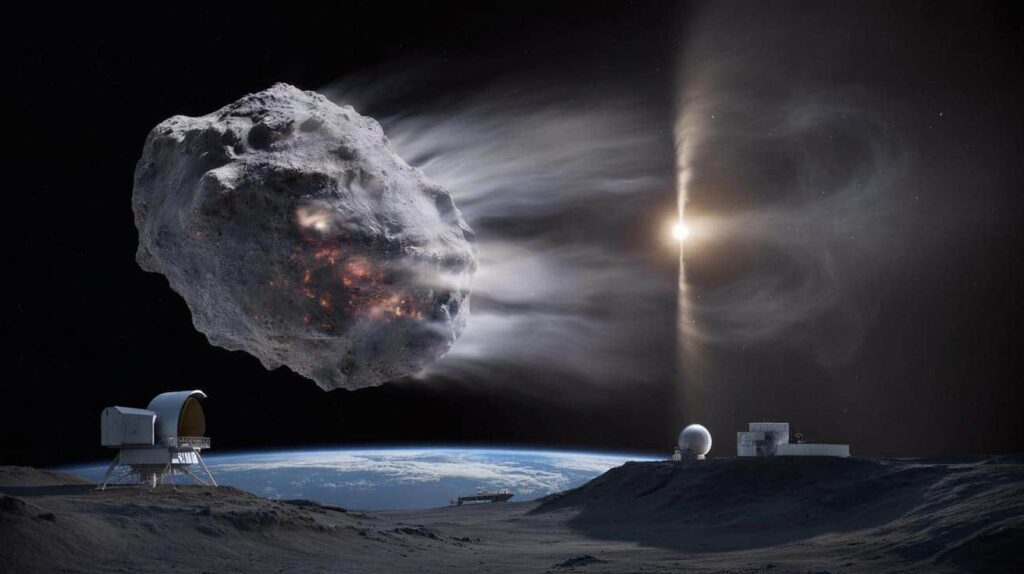
3I/ATLAS — A rare interstellar visitor
Comet 3I/ATLAS is a unique and scientifically significant object because it is only the third known interstellar visitor to pass through our Solar System, following 1I/Oumuamua and 2I/Borisov.
Its unique content and characteristics provide astronomers with a rare chance to study material from another star system, offering clues about how planetary building blocks vary across the galaxy.
Unusual Chemical Composition
-
High Carbon-Based Compounds: Observations have revealed that 3I/ATLAS is unusually rich in carbon-based chemicals, particularly methanol and hydrogen cyanide, at concentrations far greater than those typically found in comets originating in our Solar System.
-
Methanol, a simple carbon-based compound, is a crucial building block for more complex molecules tied to prebiotic chemistry and the origins of life.
-
-
High Carbon Dioxide to Water Ratio: The comet exhibits one of the highest ratios of High Carbon Dioxide (CO2) to Water Ratio seen in any comet, suggesting it formed far from its parent star in a region cold enough for carbon dioxide to become a solid.
-
Metal Content: It has shown unusual metal content, including relatively high concentrations of nickel compared to iron.
Extreme Trajectory and Speed
-
Hyperbolic Trajectory: Its path is described by an extremely high orbital eccentricity (around $6.1$), meaning it is moving too fast to be bound by the Sun’s gravity and is simply passing through on a hyperbolic trajectory before leaving the Solar System forever.
-
Record Speed: With a speed relative to the Sun of about 58 km/s (36 mi/s) when entering the Solar System, it is the fastest of the three known interstellar objects.
Coma and Tail Dynamics
-
Anti-Tail (Sunward Tail): One early surprise was the appearance of a pronounced sunward tail or “anti-tail” when it was far from the Sun. While this phenomenon can be naturally explained by the release of water-ice grains on the sunlit side, it was a longer and less common sequence than typically observed in homegrown comets.
-
Unusual Polarization: Polarimetric observations suggested that its coma is made of a mixture of icy and dark material, similar to that seen in trans-Neptunian objects.
In essence, 3I/ATLAS acts as a pristine time capsule from another star system, providing vital information about the chemical and physical conditions that existed during the formation of exoplanetary systems.