Indian Space Research Organisation (ISRO): Key Facts and Milestones
The Indian Space Research Organization (ISRO) is India’s premier space agency, functioning under the Department of Space (DoS). Established with the vision of harnessing space technology for national development, ISRO today stands among the world’s leading spacefaring institutions. Its progress reflects India’s technological rise, strategic maturity, and commitment to self-reliance.
1. Historical Background of ISRO:
India’s space journey began in the 1960s, driven by visionary leadership:
1962: Establishment of INCOSPAR (Indian National Committee for Space Research) under Dr. Vikram Sarabhai.
1963: First sounding rocket launched from Thumba Equatorial Rocket Launching Station (TERLS).
1969: ISRO created to replace INCOSPAR.
1972: Government set up Space Commission and Department of Space; ISRO placed under DoS.
Founding fathers include Vikram Sarabhai, Satish Dhawan, and APJ Abdul Kalam.
Dr. Vikram Sarabhai – Father of ISRO:
Introduction
-
Dr. Vikram Ambalal Sarabhai (1919–1971) was an Indian physicist, industrialist, and visionary who laid the foundation of India’s space programme.
-
Known as the Father of the Indian Space Programme and Father of ISRO.
The Visionary Architect of India’s Space Renaissance
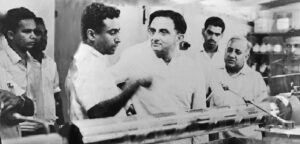
Dr. Vikram Sarabhai’s contributions laid the foundation of India’s entire space programme. He established INCOSPAR (1962), set up the Thumba Equatorial Rocket Launching Station, and played a decisive role in creating ISRO (1969). He envisioned using space technology for communication, education, weather forecasting, and national development. Sarabhai initiated India’s satellite programme, which later led to Aryabhata, and started work on launch vehicle development. He also built key institutions like PRL and helped establish IIM Ahmedabad. His leadership nurtured talents like A.P.J. Abdul Kalam, shaping India’s scientific and technological future.
2. Objectives of ISRO
ISRO’s work broadly aligns with national development, scientific advancement, and strategic capability.
-
Promote space technology and its applications for societal benefit.
-
Develop launch vehicles, satellites, and ground infrastructure.
-
Promote self-reliance in critical technologies.
-
Conduct planetary exploration (Moon, Mars, Sun).
-
Support national needs—communication, navigation, weather forecasting, disaster management.
3. Organizational Structure of ISRO
- Chairman, ISRO → Also Secretary, DoS.
- Centers divided by specialization:
-
VSSC (Thiruvananthapuram): Launch vehicles.
-
URSC (Bengaluru): Satellites.
-
SDSC–SHAR (Sriharikota): Launch operations.
-
ISAC/ISTRAC: Satellite operations.
-
LPSC: Propulsion.
-
SAC (Ahmedabad): Communication & remote sensing payloads.
-
NRSC: Data acquisition & surveying.
-
4.ISRO’s Launch Vehicle Programme: Powering India’s Ascent to Space
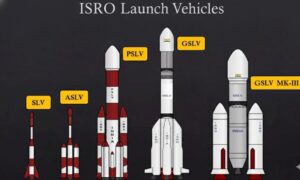
The launch vehicle programme of the Indian Space Research Organisation (ISRO) represents India’s journey from dependence to technological self-reliance in accessing space. These vehicles enable India to place satellites in various orbits for communication, navigation, remote sensing, and scientific exploration. Over decades, ISRO has built a family of launchers that reflect innovation, resilience, and strategic capability.
a.Early Foundations: SLV and ASLV
ISRO’s launch vehicle programme began with the Satellite Launch Vehicle (SLV-3) in the late 1970s. Under the guidance of scientists like A.P.J. Abdul Kalam, SLV-3 successfully launched Rohini in 1980, making India one of the few nations with indigenous launch ability.
The Augmented Satellite Launch Vehicle (ASLV) followed, serving as a technological bridge that improved staging, control systems, and solid propulsion. Though initially facing failures ASLV provided valuable learning for future rockets.
b.PSLV: India’s Trusted Workhorse
The Polar Satellite Launch Vehicle (PSLV) revolutionized India’s space ambitions. Known for its exceptional reliability, PSLV can place satellites in polar, sun-synchronous, and even interplanetary trajectories. It launched landmark missions like Chandrayaan-1, Mangalyaan, and a world record 104 satellites in a single mission.
PSLV’s versatility made India a preferred global launch partner.
c.GSLV and GSLV Mk III: Mastering Heavy-Lift Capability
To place heavier communication satellites in Geostationary Transfer Orbit (GTO), ISRO developed the GSLV, featuring the crucial cryogenic upper stage.
The GSLV Mk III (LVM3), India’s most powerful rocket, now enables 4-ton class launches and supports the Gaganyaan human spaceflight programme.
d.Emerging Technologies: SSLV and RLV
ISRO is expanding with new-generation vehicles:
-
SSLV for low-cost, rapid small-satellite launches.
-
Reusable Launch Vehicle (RLV) to drastically reduce launch costs and enhance sustainability.
5.Satellite Programmes of ISRO
a. INSAT/GSAT (Communication)
-
Provides telecommunication, TV broadcasting, meteorology, and disaster alerts.
-
Backbone for networks like DD, tele-education, telemedicine.
b. IRS (Indian Remote Sensing) Satellites
-
One of the world’s largest remote-sensing constellations.
-
Applications: agriculture, forestry, water resources, mineral exploration, disaster management.
c. Navigation Systems
-
NavIC (Navigation with Indian Constellation) – India’s regional navigation system comparable to GPS.
-
Offers civilian and encrypted military services.
6.Space Science Missions
a. Chandrayaan Programme
-
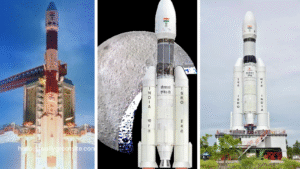
Chandrayaan-1 (2008): Discovered water/hydroxyl on the lunar surface.
-
Chandrayaan-2 (2019): Orbiter successful, though lander failed.
-
Chandrayaan-3 (2023): Historic soft-landing near lunar south pole; rover Pragyan operational.
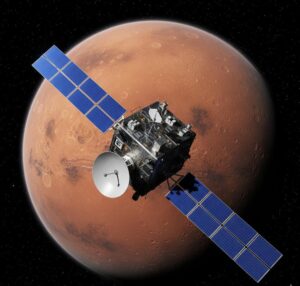
b. Mars Orbiter Mission (Mangalyaan – 2013)
-
India became first Asian nation to reach Mars orbit and first in world to do so on maiden attempt.
-
Cost-effective mission praised globally.
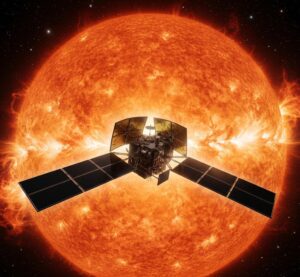
c. Aditya-L1 (Solar Mission)
-
India’s first mission to observe the Sun.
-
Positioned at Lagrange point L1 for continuous solar observations.
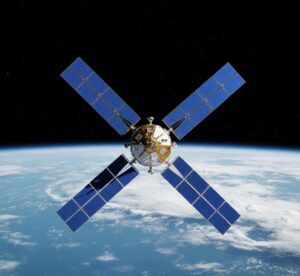
d. AstroSat
-
India’s first dedicated space observatory for multi-wavelength astronomy.
7. Emerging & High-Technology Programmes
a. Reusable Launch Vehicle (RLV)
-
RLV-TD prototypes tested successfully.
-
Long-term aim: reduce launch costs by 80–90%.
b. Small Satellite Launch Vehicle (SSLV)
-
Designed for low-cost, quick-turnaround launches for small satellites and startups.
c. Human Spaceflight Mission – Gaganyaan
-
Plan to send Indian astronauts (Vyomnauts) into Low Earth Orbit.
-
Includes test vehicles, crew module recovery, and environmental control systems.
d. Space Station (India’s space station by 2035)
-
Long-term plan for modular station supporting experiments and human presence.
e. Quantum & advanced communication
-
Quantum Key Distribution (QKD) experiments for secure communication.
. International Cooperation
ISRO collaborates with major space agencies:
-
NASA: NISAR mission (Earth observation), scientific exchange.
-
Roscosmos: Early cryogenic tech assistance.
-
CNES (France): Oceansat-3/Argos, Megha-Tropiques.
-
ESA, JAXA, Germany, UK, and many others.
India launched satellites for over 30+ countries, earning foreign revenue.
Conclusion
ISRO stands as a symbol of India’s scientific self-reliance and innovation. Its achievements—from PSLV and Chandrayaan to Gaganyaan and NavIC—have transformed India into a major space power. With expanding commercial opportunities, deep-space missions, and human spaceflight initiatives, ISRO’s future carries immense strategic, technological, and developmental significance for India, making it a vital subject for UPSC preparation.
People also search for
ISRO Important facts
ISRO, established in 1969 by Dr. Vikram Sarabhai, is India’s national space agency under the Department of Space, headquartered in Bengaluru. Its primary objective is to use space technology for national development, governance, and scientific advancement. ISRO has developed reliable launch vehicles like PSLV, GSLV, and LVM3, and operates key satellite systems for communication (INSAT/GSAT), remote sensing (IRS), and navigation (NavIC). Major achievements include Chandrayaan missions, Mars Orbiter Mission, Aditya-L1, and the upcoming Gaganyaan human spaceflight mission.
History of ISRO
ISRO (Indian Space Research Organisation) was formed on 15 August 1969, evolving from INCOSPAR (1962) under Dr. Vikram Sarabhai. Headquartered in Bengaluru, its main aim is to develop space technology for national development. Key milestones include Aryabhata (1975), SLV-3 & Rohini (1980), INSAT series (1992), Chandrayaan-1 (2008), and Mars Orbiter Mission (2013). ISRO contributes to communication, meteorology, navigation, Earth observation, and interplanetary exploration, showcasing India’s self-reliance and scientific progress.