Space Missions: A comprehensive Study
Introduction
Space Missions embodies the drive to investigate the cosmos, broaden academic insight, and utilize the orbital environment for societal progress and defense. Starting with the 1957 launch of Sputnik-1, these programs have transitioned from mere displays of cold-war engineering into sophisticated operations focused on terrestrial imaging, deep-space research, global connectivity, and tracking environmental shifts.
For an emerging economy like India, satellite programs serve as vital tools for governance, international relations, emergency response, and sovereign independence. Within the UPSC framework, these developments bridge several disciplines: history and progress in GS-I, technological and strategic frameworks in GS-III, the morality of orbital debris in GS-IV, and broader thematic discussions in the Essay Paper.
Historical Evolution Of Space Missions
Key Milestones in Orbital History
-
1957 – The USSR’s Sputnik‑1 deployment initiated the era of orbital flight.
-
1961 – Yuri Gagarin reached orbit as the initial person in flight via Vostok‑1.
-
1969 – Apollo 11, under Neil Armstrong, completed the primary crewed lunar touchdown.
The Cold War era recast orbital flight as a test of political dominance, yet it simultaneously drove breakthroughs in propulsion, metallurgy, data processing, and global broadcasting systems.
Famous Space Missions
-
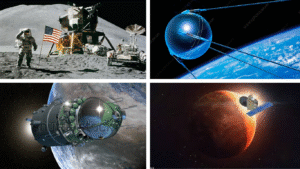
Sputnik 1 (1957):
The USSR deployed this inaugural artificial satellite, triggering the geopolitical space race and the era of orbital mechanics.
-
Vostok 1 (1961):
Yuri Gagarin attained the status of the first human in orbit, a pivotal demonstration of Soviet aerospace capability.
-
Apollo 11 (1969): NASA executed the premier crewed lunar touchdown, with Neil Armstrong and Buzz Aldrin conducting the first extravehicular activity on the Moon.
-
Voyager 1 (1977): This interstellar probe mapped the outer gas giants and remains the most distant human-engineered object in the cosmos.
-
Hubble Telescope (1990): A NASA-ESA venture that transformed deep-space observation through high-resolution visible and ultraviolet imaging.
-
Mangalyaan (2013): ISRO’s Mars Orbiter Mission established India as the first nation to achieve Martian orbit on its maiden attempt.
-
Chandrayaan-3 (2023): This mission secured the world’s first soft landing near the lunar south pole, validating India’s indigenous precision-landing technologies.
-
James Webb (2021): An international infrared observatory stationed at the L2 Lagrange point to probe the early universe and exoplanetary atmospheres.
Major Indian Space Missions
Satellite Launch Vehicle Missions
PSLV: This four-stage system serves as the backbone of India’s low-earth orbital access. Its operational flexibility allows for multi-satellite “ride-share” deployments, as evidenced by the 104-satellite C37 mission.
LVM-3: As the heaviest operational lifter, it utilizes a high-thrust cryogenic engine to insert payloads into Geostationary Transfer Orbits (GTO). It is being re-engineered as the Human-Rated Launch Vehicle (HRLV) for crewed missions.
Lunar and Deep-Space Portfolios:
Chandrayaan programme
-
Chandrayaan-1 (2008): Established India’s orbital presence; detected hydroxyl (OH) and water ice via NASA’s Moon Mineralogy Mapper.
-
Chandrayaan-2 (2019): Chandrayaan-2 deployed a high-resolution orbiter (0.3 m) that is still mapping the Moon’s surface; however, despite the lander’s hard landing, the mission remains scientifically active.
-
Chandrayaan-3 (2023): Achieved the world’s first soft landing near the Lunar South Pole, validating precise descent and roving capabilities.
-
Chandrayaan-4 (Proposed): A complex Sample Return Mission designed to retrieve lunar regolith; it will demonstrate autonomous docking and Earth-reentry technologies.
Mangalyaan (MOM)
Technological Sovereignity : India became the first nation to achieve Martian orbit in its maiden attempt and the first Asian country to reach the planet.
Frugal Engineering: Executed at a cost of approximately ₹450 crore ($74 million), it remains the world’s most cost-effective interplanetary mission.
Launch Optimization: Successfully utilized the PSLV-C25 (typically used for Earth orbits) by employing a “gravity-assist” elliptical orbit strategy to overcome lift-off mass constraints.
Onboard Autonomy: Because of the communication latency (up to 20 minutes) the craft therefore featured indigenous “self-correcting” software to manage critical maneuvers independently without real-time ground control.
Scientific Payload: Additionally, it carried five indigenous instruments, including the Methane Sensor for Mars (MSM), specifically designed to detect CH₄ as a potential biosignature for life.
Aditya-L1
Stationed at a stable gravitational equilibrium, this observatory provides uninterrupted solar telemetry, vital for shielding terrestrial grids and satellites from coronal mass ejections.
The Gaganyaan Framework:
This initiative transitions ISRO from satellite deployment to “bio-astronautics.” By developing indigenous Life Support Systems and a Crew Escape System (CES), India is establishing the technical foundation for a permanent orbital presence—the Bharatiya Antariksha Station.
International Space Missions
1 United States – NASA
-
NASA leads in deep space exploration
-
James Webb Space Telescope – studying early universe
-
Artemis Programme – returning humans to the Moon
2 Russia – Roscosmos
-
Pioneer in human spaceflight
-
Strong presence in ISS operations
3 Europe – ESA
-
Scientific missions like Rosetta and Gaia
4 China – CNSA
-
Chang’e lunar missions
-
Tiangong Space Station
-
Strategic competition with USA
CONCLUSION
Space missions are no longer confined to scientific curiosity; they are instruments of development, diplomacy, defense, and destiny. India’s journey from launching a small satellite on a bicycle to landing near the Moon’s south pole reflects the transformative power of vision, institutions, and innovation.
As India moves towards becoming a Viksit Bharat, space missions will play a decisive role in shaping economic growth, national security, climate resilience, and global leadership. For UPSC aspirants, space missions offer rich material to integrate science with society, technology with ethics, and ambition with responsibility.
People also ask
Famous Space Missions
Famous space missions mark major milestones in human scientific and technological progress. Sputnik 1 by the Soviet Union began the Space Age, while Vostok 1 made Yuri Gagarin the first human in space. Apollo 11, led by NASA, achieved the first Moon landing, symbolizing human exploration beyond Earth. Voyager 1 expanded knowledge of the outer solar system and interstellar space. The Hubble Space Telescope revolutionized astronomy through deep-space observation. India’s achievements include Mars Orbiter Mission (Mangalyaan) and Chandrayaan-3, led by ISRO, showcasing cost-effective and advanced space technology. The James Webb Space Telescope is enhancing understanding of the early universe.
Indian Space Missions
Indian space missions are designed to achieve scientific excellence while supporting national priorities such as communication, navigation, disaster management, and climate studies.
These missions are led by the ISRO, which is known globally for its low-cost and reliable space technology. Key missions include Chandrayaan-3, which demonstrated India’s capability in soft lunar landing near the Moon’s south pole; Mars Orbiter Mission (Mangalyaan), which showcased interplanetary mission efficiency; Aditya-L1, India’s first mission to study the Sun; and Gaganyaan, aimed at human spaceflight.
Which Is the most famous Space Mission
Apollo 11 (1969)
Objective: First human landing on the Moon.
Agency: NASA
Astronauts: Neil Armstrong, Buzz Aldrin, Michael Collins
Achievement: On 20 July 1969, Neil Armstrong became the first human to walk on the Moon. Significance: Major milestone of the Space Race during the Cold War Demonstrated advanced rocketry, navigation, and human spaceflight capability Inspired future lunar and planetary missions